Though early Baltic tribes rebuffed Jewish settlements, they came in the later part of the 16th century after the country came under the control of Denmark, Poland and Lithuania. The Duchy of Courland — a vassal state of Poland in the western part of Latvia — actively invited Jews to settle, bringing their skills with them.
The Jews who came to the Eastern part of the country, including the nation’s capital, did not fare so well. These settlements were made up of Belarus, Polish and Litvak (the term for Lithuanian Jews), who adhered to the Yiddish culture and language. They were not able to stay overnight in Riga. Certainly, that prevented Jewish merchants from bringing and selling heavy goods from across the river.
Still, the population grew. Following displacement from retreating Russians during WWI, they returned. During the early part of the 20th century, there was a Jewish population of nearly 100,000, but they were prevented from working in government and many other trades until about 1920, when there were Jews represented in Parliament and other governmental positions. Jews spanned the whole spectrum of political beliefs, from left to right. With economic downturn, many were forced into bartering and peddling small goods.
The Soviets invaded Latvia in 1940, deporting Jews and their leaders to the farthest interior of the USSR in 1941. A week later, the Nazis invaded Latvia. That summer and fall, most of the Latvia’s Jewish population had been executed. Then, the Nazis brought in Jews from Mittlel Europe to work in labor camps — Latvia is a source of peat and other natural commodities. Thousands died from the harsh conditions.
Most of the Holocaust survivors emigrated to Israel, while those in Soviet Russia came back to Latvia, mostly to Riga.
Some Latvian collaborators with Nazis were brought to trial as war criminals by the USSR.
After Latvia gained independence from the USSR in 1991, there was an increased acceptance of Jewish Latvians as part of the cultural fabric of the country. The following decade saw authorized and financially supported creation of Holocaust memorials. Still, the Jewish population for the whole country is said to be 8,000.
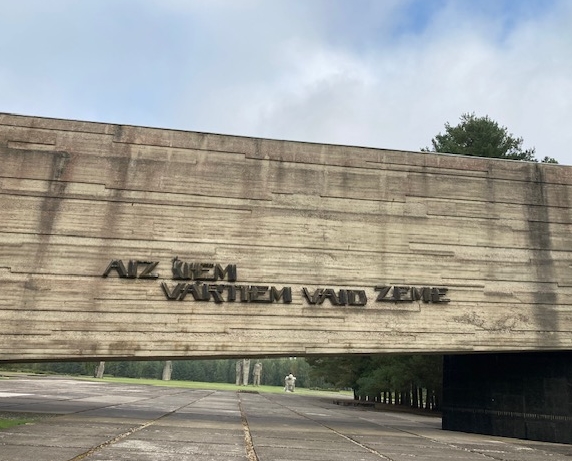
Salaspils Memorial Ensemble is a haunting collection of monuments on the site of a Nazi labor prison camp. It’s about a half hour from downtown Riga and dogs are allowed. With the large expanse of meadow and tree groves, there’s enough space to be contemplative. This is what they say about it:
“The memorial creates a symbol of the border between life and death with a 100 metre-long concrete wall, on which is written – “Beyond these gates the land groans”. There are also seven concrete sculptures: “Mother”, “The Unbroken”, “The humuliated”, “Protest”, “Red Front”, “Solidarity”,“The Oath”. The Salaspils Memorial Ensemble is part of Latvia’s cultural canon.”




The Old Jewish Cemetery in Riga is said by some scholars to be the final resting place for 1,000 victims of the Riga Ghetto, but other scholars don’t think the numbers are so high. The cemetery has been destroyed, but there’s now a memorial park.


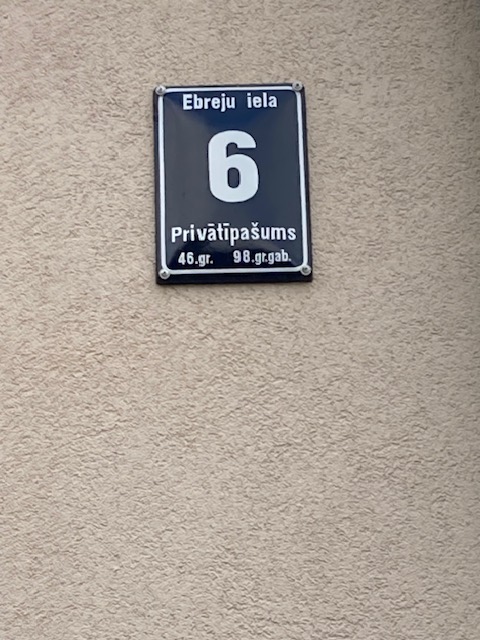
Bordering the cemetery is Ebreju Iela — “Jewish (or Hebrew) Street”.
It’s daunting to think of the lives — and future lives — that were snuffed out. My mom taught us when we were little that things would be different for us, because so many of the Holocaust victims and their descendants would have probably emigrated to the US and that we would never know them. I think she was talking about finding Jewish people to marry and I have to say, there’s something to that.
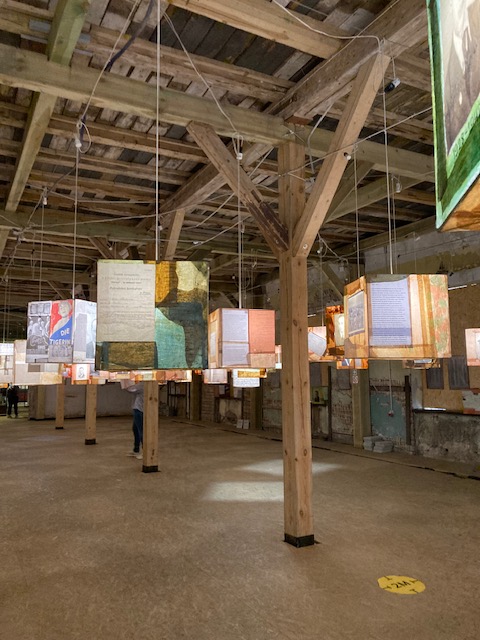
The Museum of the Riga Ghetto and Holocaust in Latvia is a free museum in a vintage warehouse near where the ghetto was. Since it has concrete floors, I did see some locals bringing dogs. One of their interesting exhibits is filled with hanging paper lanterns covered with photos and letters (along with translations) of some of the last days of local victims.


Riga has a memorial to what are popularly called the “Righteous Gentiles”, those Christians of Latvia who risked their lives to save Jews during the Holocaust.

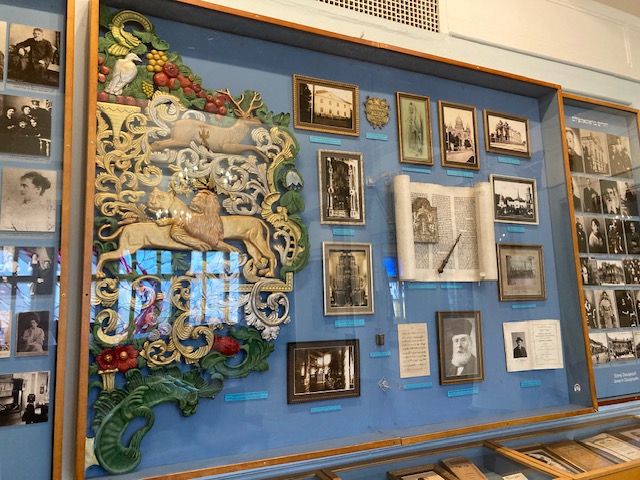
So, it’s uplifting to learn what is happening with the Jewish population of Latvia today. The Jews in Latvia museum has a collection of rare photos and items from over a century ago, as well as a gorgeous performance space. The space hosts all kinds of acts important to Jewish heritage, such as dancers and klezmer bands.
The museum is careful to show the full spectrum of Jews of Latvia. Sure, there are posters and ads of great mercantile leaders. But there’s also a haunting photo of a peddler — with no horse, no cart — heading up a dusty road with just a heavy rucksack on his back. This is not a drawing from hundreds of years ago, but a photo taken during my grandparents’ lifetimes.
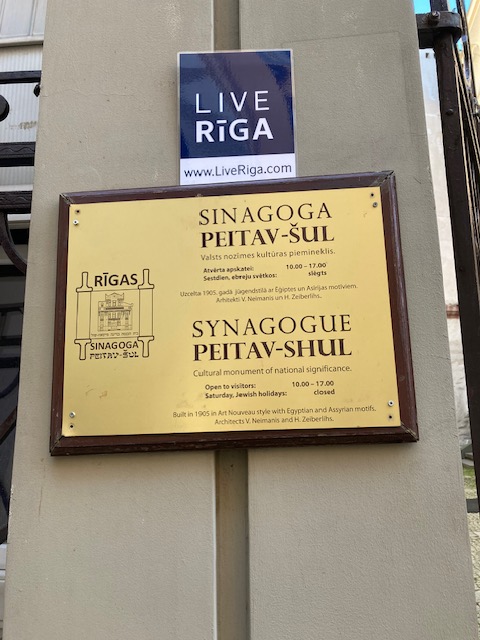
Only one synagogue was spared in Riga during WWII: Peitav Shul. Though its location on a hidden little side street was probably originally considered a less than desirable location, that turned out to be its saving grace: it was too close to other buildings to be safe to burn.
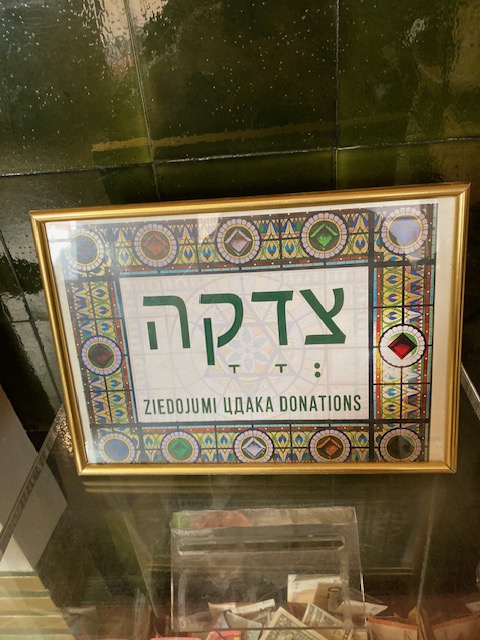
I can’t tell you how proud of myself I was to figure out that the Cyrillic said “Tzedakah”. That is a word that now denotes charity, but in a way of helping people to help themselves — not a straight handout. It’s not a voluntary thing, but a religious obligation in Judaism to be generous. I always say, “Neil Sedaka’s family must’ve been soooo generous!” That’s probably true; that’s how the old-timers often got their last names during the Napoleonic wars.
The sanctuary has been restored to its Egyptian-themed decor.

I did attend their Shabbos services on Saturday morning. They’re held in the basement, which might be a security thing — I don’t know. Security was tight, involving both municipal and private security, a security booth, showing of id and questions reminiscent of getting on an El Al flight.
I was glad I wore my most modest garb: black dress covering collarbones, elbows and knees, as well as a hat: they are Orthodox in practice. At first, there was a language barrier in which I didn’t understand it was a segregated (separate men and women) shul. I just thought that the place wasn’t popular with women! I got some glares, including from the rabbi. There was a solid screen between the two sexes, so one would not have been aware there were women on the other side. I don’t even remember how or who showed me the way . . . I was out of my element!
By the way, I took these photos the day before: it’s not acceptable in those circumstances to be using any kind of machinery on the Sabbath, including a phone.
I was a little surprised that the only synagogue was Orthodox, because I’m sure that the remaining Jewish population of Riga is not. But they’re definitely doing it old-school!


 Luxe & Down-Home Cuisine/Culture/Travel/Style